
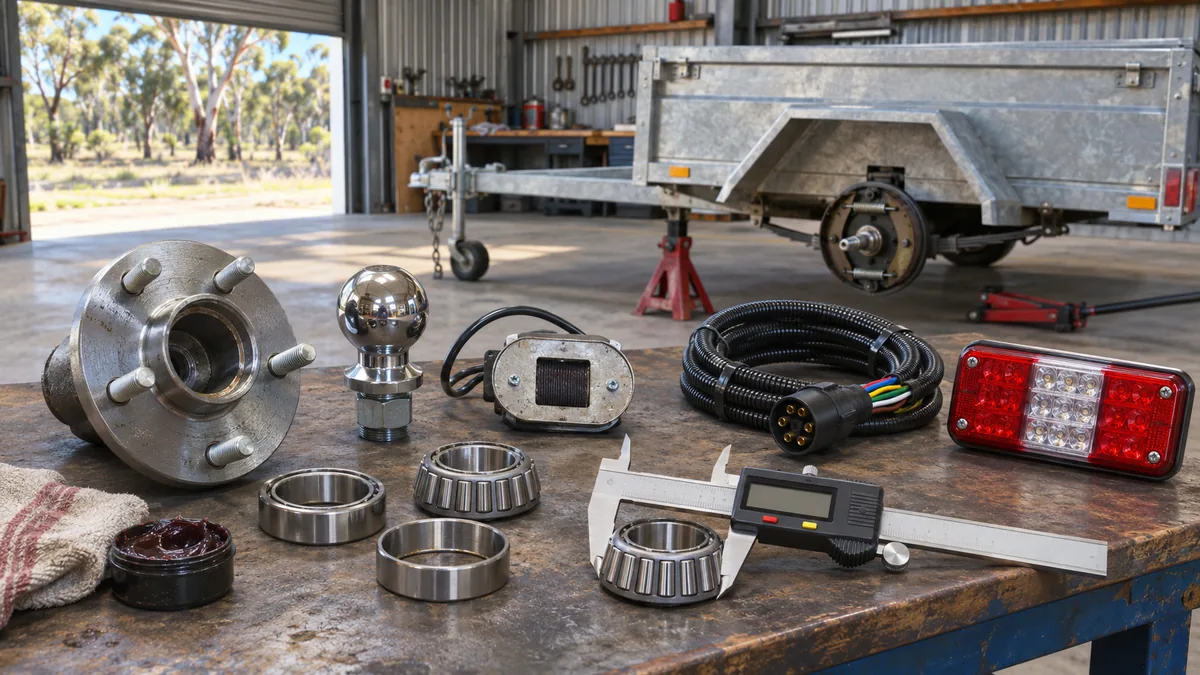

Trailer parts that look right can still be incompatible with the assembly. A bearing that slid on and a light that lit up on the bench can still create trouble once load and road vibration enter the picture. Matching ratings and dimensions to the trailer as a system matters more than skill with tools.
Table of Contents
Any bearing that slides on is fine
This myth survives because bearings look simple. Steel rings and rollers don’t show load limits at a glance. That plain look tempts many builders to match by eye or feel.
Every trailer hub runs on a matched inner and outer bearing set. Each half has inner and outer bearing numbers that correspond to exact cup and cone dimensions. The seal size and spindle diameter must line up with those numbers as well. A part that slides on with light pressure can still be a few thousandths off.
That slack can’t be seen but it can be felt later as heat and rumble. The loose fit hammers the spindle under load. Wear builds with every mile. By the time noise appears the hub bore is often scored too.
Looks can mislead badly.
Dust and water find the gap first. A hub that ran cool for years can turn hot in a single trip. Ordering by stamped numbers and measured bores takes a few extra minutes, yet it prevents the kind of spindle damage that forces a full axle swap later.
The safe path is dull but reliable. Read the old numbers and measure with calipers. Match the seal to the manufacturer’s specifications and check the load rating for the axle. A qualified technician should assess fit and function using the manufacturer’s procedure and applicable rules.
A 50mm ball suits any 50mm coupling
The second myth sounds logical. If the ball measures 50mm and the coupling is stamped 50mm then they must match.
They don’t match automatically. Diameter is only one part of the design. Coupling class sets latch geometry and load rating for a given load range. Two couplings with the same mouth size can have very different ratings and wear limits.
The ball shank and mount rating must also suit the trailer mass and tongue load. A mismatch rarely fails in the driveway. It shows under braking and sway when forces spike. The latch can chatter or wear fast when profiles don’t line up.
That wear isn’t always visible until the coupling pops under shock load. The compliance plate and coupling stamp provide the ratings, which memory or brand loyalty can’t replace. Both ball and coupling must be compatible and rated for the same system mass and use. A qualified technician should assess the pairing against the manufacturer’s requirements and applicable rules before towing.
Towing guides often reduce the choice to diameter alone. That shortcut hides the rest of the system. The tow vehicle hitch and ball mount carry ratings that must line up with the coupling and the loaded trailer mass for safe towing.
Brake magnets are all the same
Electric brakes look uniform from the outside. A magnet is a magnet, so any replacement should pull the same. That’s not how these parts behave.
Amperage draw and torque output differ between makers and even between product lines. One side can grab harder when mixed parts are used in the same axle set. The trailer doesn’t stop crooked in a dramatic way at first. It drags a little on one wheel and wears that lining faster. Heat builds on the hot side while the other side stays cool.
Over time the imbalance grows and adjustment can’t hide it. The breakaway kit adds another layer that many owners forget during swaps. That battery unit must match system voltage and be able to hold full braking if the rig separates. If the magnets draw more current than the kit was sized for, performance drops when it is needed most.
Controller design and compatibility vary. A qualified technician should check the controller, wiring and brake assemblies together rather than infer performance from wire colors or whether a replacement bolts into place. The appropriate checks come from the manufacturers’ specifications for the actual system.
The safe approach treats brakes as a complete system. Ratings need to line up with wiring capacity, and a qualified technician should assess function and test according to the manufacturer’s procedure.
A superseded number means the same part
Part numbers cause quiet trouble. A box arrives with a different number than ordered and the seller says it’s a direct swap. Sometimes that is true.
Makers update designs and roll old numbers into new ones for fit or material changes. The new item can have a revised seal lip or a thicker flange that still suits the same hub. It can also suit a different axle series that looks close but carries a different load rating. There’s no way to tell by shape alone.
The only reliable check is manufacturer data that shows what supersedes what and what limits apply. Don’t trust a marketplace title that says compatible with everything. Many builders now source trailer spare parts through a specialist supplier that keeps cross-reference data current and flags when a change alters fit or rating.
That extra check takes minutes and it beats pulling a hub apart twice. Photos hide thickness and thread pitch. A flange that looks identical in a thumbnail can differ by a millimeter in offset, which is enough to stress a seal or leave a gap for dust. Keep receipts with numbers written on them.
Keep the old number and the new number with the trailer records for next time. Fitting a higher-rated item doesn’t raise the lawful capacity listed for the trailer. The plate rating still governs what can be carried legally.
An axle is defined by length alone
Axle shopping by tape measure is common. If the old beam measured a certain length then any beam with that length should work. Length is only the start.
Track width sets tire clearance and bearing spread for stable tracking. Spring seat placement determines where load enters the beam and how stress spreads, while rated load capacity defines what the beam can carry in service without fatigue. Two beams of equal length can have very different ratings and tube thickness.
An underrated beam won’t bend on installation. It fatigues over months of rough roads and potholes. The compliance plate and weight distribution data show what the whole system needs.
A qualified technician should review those ratings against the manufacturer’s requirements and applicable rules before parts are chosen. Seat centers and hub faces need direct measurement, not guesswork from photos. Small errors here shift tire wear and bearing load for the life of the trailer.
Even a short shift in seat position changes bending moments in the beam, so an axle that fits the hangers may still be wrong for the load path. That error doesn’t rattle on day one. It works the metal with every bump.
Any LED light and harness will work
Lights feel like the easy swap. If the plug fits and the lamp glows then the job looks good. Road compliance needs more than glow.
Photometric output and current draw must suit the trailer system and tow vehicle electrics. Cheap universal lamps often miss on output pattern or draw too little to trigger detection. Thin cable adds another fault that won’t show on the bench. Voltage fades down a long run of undersized wire.
Lamps glow dim or flicker at idle. The fault is often blamed on the lamp when the wire is at fault. Wiring standards also differ between markets in color and pin use.
An imported harness built for a different market can land indicator and brake feeds on the wrong pins. The result is a roadside defect with signals that confuse other drivers. A lamp that draws far less current than the original can confuse bulb-out warnings or trailer detection in some tow vehicles, which then cut power or flash fast. Moisture sealing matters as much as brightness.
Match lamps and cable to the manufacturer’s specifications for length and load, and have a qualified technician assess function and test to applicable rules. Bright on the driveway doesn’t mean correct on the road.
Small hardware does not need exact specs
Wheels and clamps get less attention than bearings and brakes. That’s a mistake because small errors here carry large loads. Stud pattern and offset must match hub and guard clearance exactly.
A near miss on bolt circle diameter lets the wheel seat off center. Studs then carry shear they were never sized for. Wobble and stud fatigue follow. Wheel loss is the end stage.
Suspension U-bolts cause similar grief when reused past their life. These clamps hold axle and springs in one pack. Threads stretch in service and the naked eye can’t judge the loss. A stretched bolt can look fine yet let the pack shift under braking.
Torque specs exist for a reason on wheels and clamps. Too loose permits movement and too tight harms threads. The correct values come from manufacturer data, and a qualified technician should apply them according to the specified procedure.
Galvanic reaction deserves a mention where steel meets aluminum. Alloy hubs and lamp bodies need the right isolators, or corrosion eats the joint from inside. Isolators and coated fasteners break that path, yet they are often left out when a quick swap reuses old bolts. Fresh hardware costs little next to a lost wheel.
A qualified technician should check pattern and offset against the manufacturer’s specifications.
Most trailer trouble comes down to identifying the correct parts. Check numbers and ratings against the plate and let a qualified technician assess fit and test before the first loaded trip. Trailers reward that patience with steady miles.
